You picked a template, added your logo and hit publish. A week later you search for your own business and it's nowhere. You're not alone, and the fix usually isn't technical. It's the words on the page.
Website builders like Wix, GoDaddy and Squarespace make it easy to look professional. What they can't do is tell Google what your business actually does, who it's for and where you work. That part is your copy. Here are five changes that help a service business get found, in plain English.
Why DIY websites don't show up
Google ranks pages by matching them to what people search for. A plumber's homepage that says "Quality service you can trust" gives Google almost nothing to match. Compare that with "Emergency plumber in Orlando, FL: burst pipes, water heaters and drain cleaning." The second one tells Google the service, the urgency and the city in a single line.
Most template sites have three gaps:
- No city or service area. Local searches almost always include a place ("near me," a town name or a ZIP code).
- Vague service names. "Solutions" and "services" instead of the words customers type, like "drain cleaning" or "roof repair."
- One page for everything. Every service crammed into one list, so no page is the best answer for any single search.
Say exactly what you do, and where
Your homepage headline, page title and first paragraph should name your main service and your city. Every builder has a place for this: look for "SEO settings" or "page title" in the page settings. Write it the way a customer would search, not the way a brochure would read.
Answer the questions customers ask
People rarely search for a business name. They search for a problem: "why is my AC blowing warm air," "how much does a new roof cost," "how to get found on Google." When your pages answer those questions in plain language, you show up for them, and you earn trust before the first call.
Write down the five questions you hear most on the phone. Each one is a heading on your Services page or an FAQ waiting to happen.
Give each service and area its own page
One "Services" page that lists ten things competes weakly for all ten. A dedicated page for your most profitable service, and a Service Areas page that names the towns you cover, gives Google a clear best match for each search. Start with your top service and your top three towns.
Answer 20 questions and get your website copy written for you, starting at $49.99.
Give Google (and people) proof
Years in business, licenses, insurance, real reviews and photos of finished work all belong on your site in words, not just in badges. Link your website from your free Google Business Profile, and make sure your business name, phone number and address match everywhere they appear.
Tell Google your site exists
Google Search Console is free. Add your site, submit your sitemap (most builders create one automatically at /sitemap.xml), and Google will show you which searches you appear for. It's the simplest way to know whether your changes are working.
How Clear Content SEO writes this for you
Clear Content SEO turns the questions above into a short questionnaire. You pick your industry, then answer 20 plain-language questions about your customers, services, experience and service area. There's a "Help me answer this" button on every question if you get stuck.
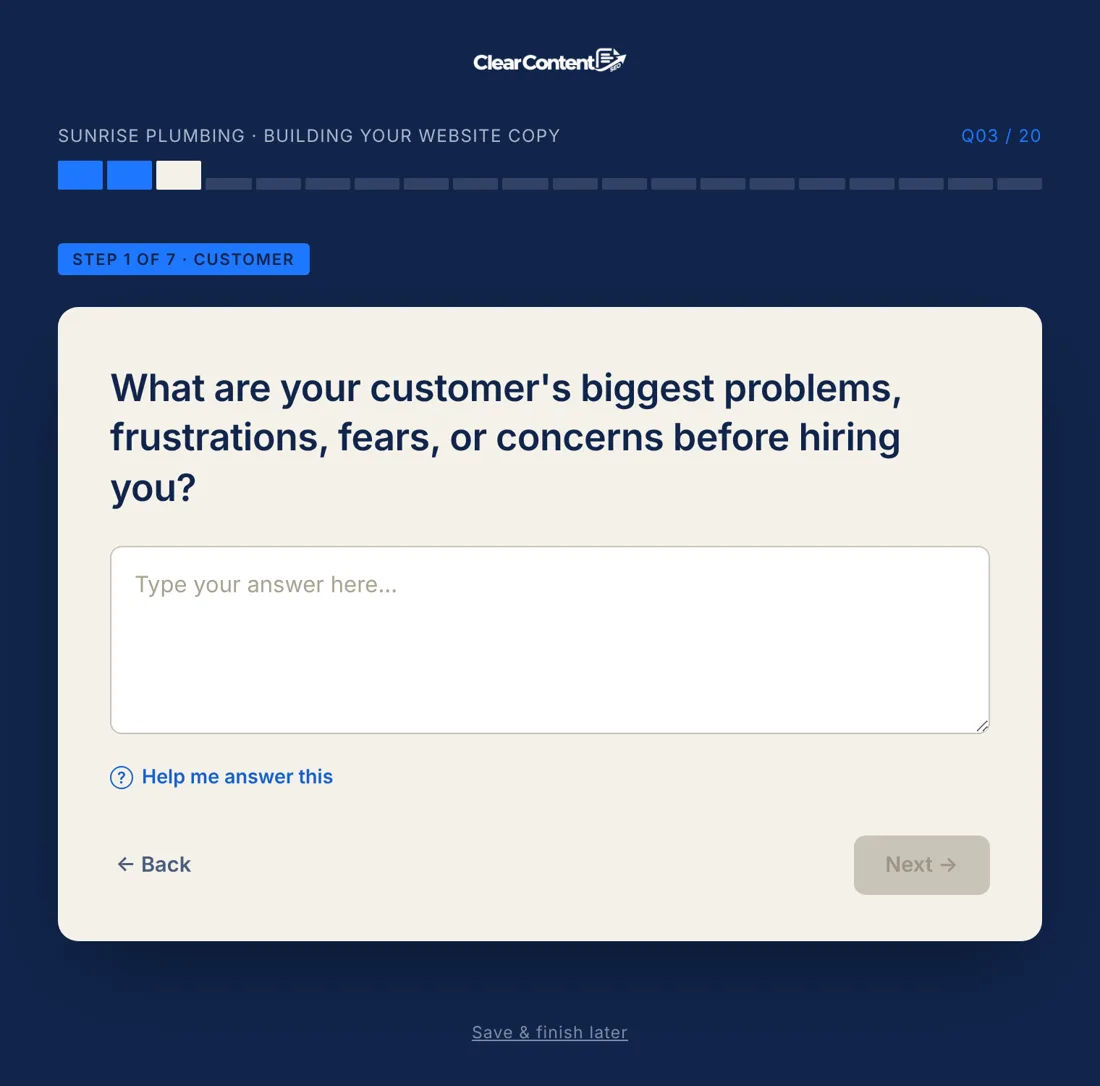
On the last step you choose your pages. Home, About, Services and Contact are included, and the add-ons recommended for your industry are starred, like Service Areas and FAQ for plumbers. Your copy arrives by email right after checkout. Paste each section into your Wix, GoDaddy, Squarespace or WordPress template and publish.
FAQ
How long does it take to show up on Google?
It varies. A new page can be found within days once Google crawls it, but ranking well for competitive searches usually takes weeks to months. Clear, specific copy and a submitted sitemap help Google understand your pages sooner.
Do I have to pay Google to show up?
No. Showing up in regular (organic) search results is free. Google Ads are a separate, paid option. Good website copy helps your organic results.
Can a Wix, GoDaddy or Squarespace site rank on Google?
Yes. All three let you edit page titles, descriptions and headings. What usually holds these sites back is template text that never says what the business does or where.